AI for marketing: A practical cheat sheet for SMBs
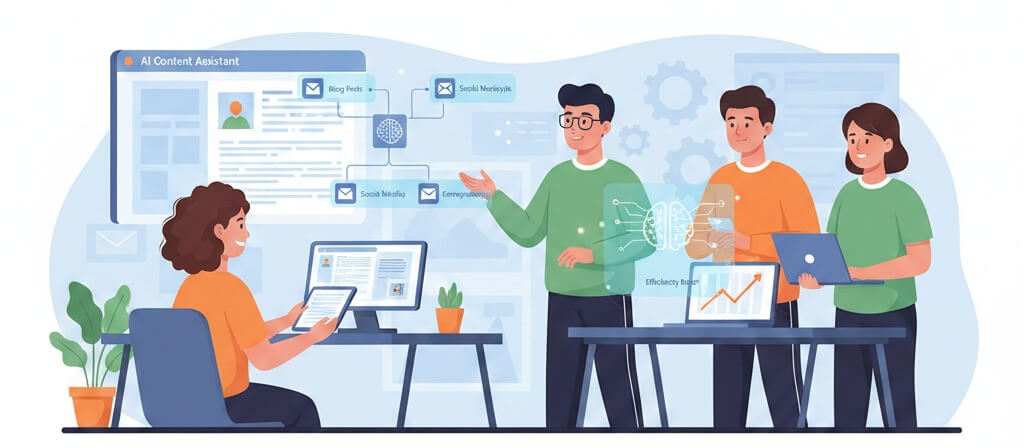


For established small and medium businesses (SMBs), AI (artificial intelligence) isn’t about replacing marketers, it’s about amplifying expertise. This guide explains how to integrate AI into marketing workflows safely and efficiently, helping your team work faster, reduce friction, and free up time for higher-value decisions, without compromising strategy, quality, or brand integrity.
Why AI should support (not replace) your marketing expertise
In mature businesses, marketing is less about experimentation and more about optimisation. AI can be a powerful ally when used to handle repetitive or data-heavy tasks, but it shouldn’t drive strategy or final outcomes.
Andrew Raso, Founder and Global CEO of digital marketing agency, Online Marketing Gurus, puts it simply:
“Real expertise still sits at the centre of everything we do, from best practice through to implementation. AI supports our workflows, but it isn’t infallible, which is why human judgement always has the final say.”
For SMBs and startups, the operational takeaway is clear: use AI to remove friction, not to make decisions. This reduces risk while giving your team more capacity for higher-value work.
Where AI adds real value in marketing
Artificial intelligence in marketing works best in areas that are process-heavy, repetitive, or data-intensive. Practical applications include:
1. Research and insight
- Synthesising large volumes of market or keyword data
- Identifying patterns in customer behaviour or engagement
- Stress-testing creative concepts before investing time in production
2. Drafting and content support
- Generating initial content drafts for blogs, emails, or ads
- Producing quick summaries of reports or analytics
- Suggesting variations for A/B testing without manually rewriting everything
3. Workflow efficiency
- Automating routine administrative tasks, such as tagging, categorising, or formatting content
- Highlighting anomalies or outliers in campaign performance that need human review
- Supporting consistency across channels and campaigns
Practical example: A B2C retail SMB could use AI for marketing by drafting product descriptions across hundreds of Stock Keeping Units (SKUs). Marketing specialists then review and refine these drafts, ensuring brand voice and accuracy. Through strategic marketing automation, AI can handle the heavy lifting, humans ensure quality.
Guidelines for safe and effective AI use
Even experienced operators should treat AI marketing for SMBs cautiously. Key principles include:
- AI as first draft, not final output: Always review and refine AI-generated material before publication
- Prioritise strategy and human judgement: AI is a tool, not a decision-maker. Final approvals, creative direction, and interpretation should remain human-led
- Test, measure, iterate: Run controlled experiments to understand where AI improves efficiency and where it introduces risk
- Document workflows: Clearly define which tasks are AI-assisted and which are fully human to avoid misalignment
- Train AI with business-specific data: The more context your AI has, the better it can support your team while remaining aligned with your goals
Andrew says,
“We actively encourage our teams to test tools, share learnings and pressure-test assumptions. At the same time, we document where AI fits into workflows and where it doesn’t.
That balance between experimentation and governance is what allows us to innovate without compromising results.”
Key takeaway: By embedding artificial intelligence in marketing workflows rather than outsourcing decisions, SMBs can save time without compromising the insight or quality that comes from experienced marketers.
Balancing efficiency with compliance and quality
- Be mindful of search engines: Google can penalise purely AI-generated content, so human review is essential
- Keep control over brand tone, legal disclaimers, and compliance messaging
- Focus on what AI gives back – more time for strategy, optimisation, and higher-value customer engagement
Andrew says,
“Used poorly, AI creates uniformity. Our role is to ensure AI sharpens strategic differentiation.”
Steps to integrate AI in your marketing workflow
Step 1: Identify repetitive tasks
List processes that are time-consuming or data-heavy but don’t require strategic judgement.
Step 2: Apply AI selectively
Use AI for drafting, analysis, or summarisation, leaving final decisions to your team.
Step 3: Test and monitor
Track efficiency gains and check output quality regularly to adjust processes.
Step 4: Share knowledge internally
Document insights, best practices, and lessons learned for your team to use and refine over time.
Andrew says,
“AI won’t replace marketers, but marketers who know how to work with AI will outperform those who don’t.”
Key takeaways
- AI should accelerate work, not replace human decision-making.
- Treat AI outputs as first drafts; human review ensures quality and compliance.
- Embed AI in workflow, not in strategic decision-making.
- Testing and documentation are critical to safe, effective AI use.
- Efficiency gains free up time for higher-value tasks and strategic thinking.
Reflection
Consider your current marketing workflow: which repetitive tasks could AI safely handle to give your team more time for strategic decisions?


Subscribe to updates
Get the latest news and payment insights from Eway hot off the press.