Australia’s surcharge rules are changing.

Here’s what that means for our software platforms and merchants.

Updated on 30 June 2026 

The Reserve Bank of Australia (RBA) has finalised reforms to card payment surcharging and interchange fees, effective 1 October 2026. As your payments partner, we’re committed to making this transition straightforward for your business.

We are currently in the planning and preparation phase, working closely across teams to ensure everything is in place for a smooth transition for our partners and customers.

What has the RBA decided?

On 31 March 2026, the RBA released its final Conclusions Paper on Merchant Card Payment Costs and Surcharging.

The key decisions are:

  • From 1 October 2026, merchants will no longer be permitted to apply surcharges on Visa, Mastercard and eftpos card payments, following the RBA’s removal of restrictions on scheme no-surcharge rules.
  • Consumer credit card interchange will change from 1 October 2026. We will assess any impacts to our pricing arrangements and communicate any changes applicable changes separately.


Key dates shared by the RBA

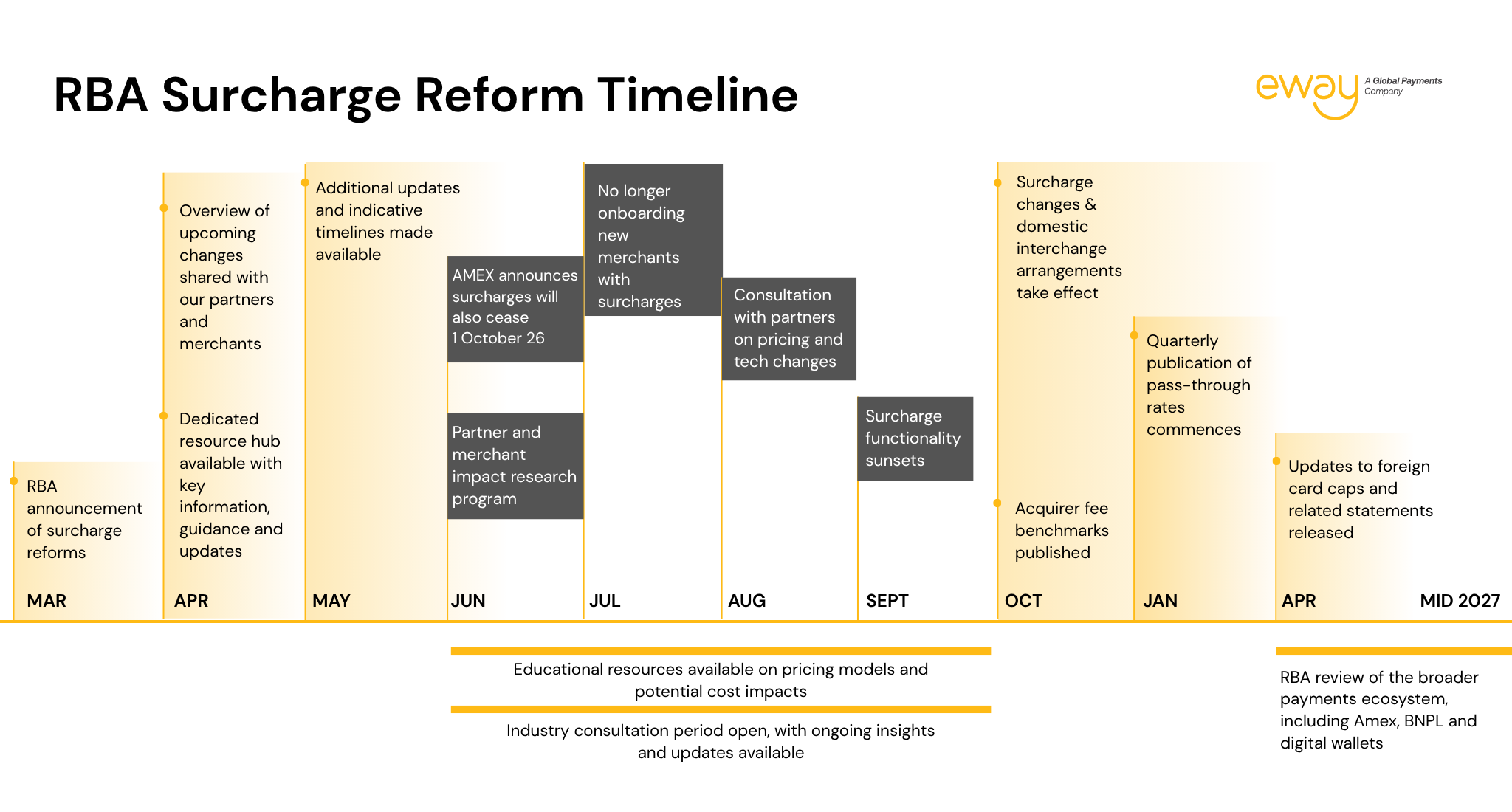
  • 01 October 2026, Surcharge ban + domestic interchange cuts
  • 30 October 2026, Acquirer fee benchmarks published publicly
  • January 2027, Pass-through rates published quarterly
  • 01 April 2027, Foreign card cap + enhanced statements
  • Mid- 2027, New RBA review: Amex, BNPL, wallets

American Express surcharge update

In early June, American Express (AMEX) has also announced that surcharging will no longer be permitted on AMEX card payments in Australia from 1 October 2026.

This is a separate change from the RBA regulations relating to Visa, Mastercard and eftpos and aligns the treatment of American Express with other major card networks

The change applies specifically to AMEX card surcharging and does not change how payment processing fees are applied.

What this means for your business

  • From1 October 2026, you can no longer surcharge or pass the card transaction cost to your customer.
  • Card acceptance costs will need to be incorporated into your advertised pricing or absorbed.
  • Non-payment surcharges (e.g. weekend, public holiday) are unaffected.
  • Your customer experience remains unchanged from October 2026.
  • Any pricing impact will vary depending on factors such as the current pricing structure, transaction mix and card types.
  • We are currently reviewing the changes and will communicate any updates where applicable.
  • You will receive communication on applicable changes on fees or pricing before 1 October 2026.

To prepare for these changes, we will no longer be onboarding surcharged merchants from 1 July 2026.

  • In preparation, our partners should review and update the following across their business:
    • Ensure sales and customer-facing teams are aligned on how fees are positioned to new merchants, moving away from passing on card costs.
    • Onboarding and customer journeys, forms or communications
      should no longer reference surcharging or fee pass-through.
    • Customer-facing experiences like hosted payment pages should have all references to passing on card fees removed.
    • Marketing, product and sales collateral used when acquiring or onboarding new merchants, should no longer mentions surcharging or fee pass-through.
    • Surcharging functionality will need to be disabled to support compliance with the new rules from 1 October 2026.
  • Existing fee-free or surcharge-based arrangements may require review and could be impacted by the reforms.
  • Merchant agreements and onboarding flows will need to be updated.
  • This is an opportunity to review embedded payments costs alongside your merchants.

What merchants need to know about the changes

One of the most common questions we’re hearing is whether payment fees are disappearing. 

The answer is no. 

From 1 October 2026, businesses will no longer be permitted to apply a surcharge to Visa, Mastercard, eftpos and American Express (Amex) card payments. However, businesses will generally continue to incur payment processing costs when customers pay by card. 

 Payment fees aren’t disappearing. The key change is that businesses can no longer recover these costs through a separate card surcharge.  

Want to learn more? 

Read our practical guide explaining what is changing, how to determine whether your business may be affected, and what steps you can take to prepare. 

Read the article

What this looks like in practice for merchants

Today (Before 1 October 2026)  After changes (From 1 October 2026) 
Businesses can apply a surcharge to card payments Surcharges on Visa, Mastercard, eftpos and Amex card payments are no longer permitted in Australia from 1 October 2026 
Payment processing fees apply when accepting cards Payment processing fees still apply when accepting cards 
Customers may see an extra charge at checkout No separate surcharge can be added at checkout 
Businesses may use surcharging to offset payment costs Businesses will need to consider how costs are managed within their overall pricing model 
Ancillary fees such as dishonour and admin fees can be passed on to customers There are no changes to these fees under the reform, the reform affects transaction surcharges only 

What this means for your business

No. Businesses will generally continue to incur payment processing costs when customers pay by card. The changes relate to surcharging, not the underlying costs of accepting card payments. 

No. These changes apply to card payments and do not affect direct debit payments from bank accounts. 

The surcharge changes apply regardless of whether a card payment is one off or recurring.

While the Reserve Bank of Australia’s (RBA) reforms apply to Visa, Mastercard and eftpos payments, American Express has separately announced that surcharging on Amex card transactions will also end from 1 October 2026.

You may currently be applying a surcharge if: 

  • Customers see an additional charge when paying by card  
  • A surcharge appears on customer receipts  
  • Your payment terminal automatically adds a fee to card transactions  
  • Your software platform is configured to apply a surcharge  

You may also find information about your surcharging arrangements or payment fees in your agreement with your payment service provider.

Understanding how much income your business currently receives from surcharges may help you prepare for the upcoming changes. 

You may be able to find this information by: 

  • Reviewing transaction reports  
  • Reviewing settlement reports  
  • Speaking with your accountant or bookkeeper  

If you’re unsure where to find this information, please contact our support team. 

Every business is different. Businesses should consider their own circumstances when deciding how to manage payment costs following the end of surcharging. You may wish to seek advice from your accountant or business adviser.

No immediate action is required. 

However, now is a good time to: 

  • Understand whether your business currently applies a surcharge  
  • Understand how much income your business currently receives from surcharges   
  • Review how payment costs are currently managed within your business  
  • Stay informed about upcoming changes 

What happens next, and how we will support you

We are taking a phased approach to ensure we can carefully plan and prepare while supporting merchants and platform partners through each stage of the transition.

Here is what you can expect from us:

  • To prepare our partners for the change, we will no longer be onboarding new surcharged merchants from 1 July 2026.
  • Throughout August, we will communicate directly with partners on any changes that may impact them, including changing, when and any actions required.
  • We will then notify all affected merchants directly, or through software partners, with personalised guidance on what needs to change and by when.
  • We are planning platform updates to remove card surcharging functionality ahead of the 1 October 2026 deadline. We will proactively review our merchant service fee rates to ensure they reflect any cost reductions that we gain and pass savings through to our partners.
  • Nothing changes immediately. Our phased approach towards the 1 October 2026 deadline, will give you time to prepare, and we will support you every step of the way.
  • Our team will be available to answer your questions and walk through any implications for your business. If you have further questions before then, please contact us here 

Your next steps

We are committed to making this transition as seamless as possible for every merchant and platform partner.

To help you prepare, we recommend the following: 

  1. Review whether you currently apply a card payment surcharge.
  2. Check if your payment plan is fee-free or relies on auto-surcharging.
  3. Look out for direct communication from us with personalised guidance.
  4. Publicly available industry information may help businesses understand broader market changes. However, individual pricing outcomes vary based on business characteristics and commercial arrangements.
  5. Contact us if you have questions — we’re ready to help now.

“This is one of the most significant changes to Australia’s payments landscape in decades, and we’re committed to guiding our partners and merchants through it with clarity and confidence, so they are prepared ahead of the deadline. Our focus is to make the transition seamless and work closely with our partners and merchants to make sure they’re not just compliant, but well‑positioned to thrive in a more transparent, lower‑cost payments environment.”

Alison Morris, General Manager, International Integrated and Platforms

Have further questions?

Our team will be available to answer any questions and walk through the implications for your specific business. If you have further questions before then, please contact our support team on support@eway.com.au or call us on 1800 870 248.